Grains Research and Development

Weedlinks

Windrow burning in northern NSW

Windrow burning is a common technique used in WA for weed control. As yet it is not used extensively in NSW. This video tries to address some of the potential issues that may be slowing its adoption in northern NSW.

Australian Herbicide Resistance Initiative (AHRI) Video: Preserving glyphosate through diversity

Integrated Weed Management

The information is categorised under the headings below. Click on the link below to go to the section you require

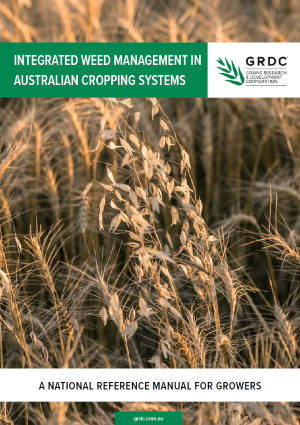
Integrated Weed Management manual

Title
Website Location
Integrated Weed Management manual
The Weeds CRC’s world-class Integrated Weed Management manual, describes a broad range of chemical and non-chemical tactics for weed management aimed at reducing the weed seedbank and the selection pressure for resistance on herbicides. The full 256 manual is available for free download.

IWM Manual contents:

IWM Manual Introduction

Economic benefit
Outlines the economic benefits of IWM in Australian cropping systems using computer model simulations.

Herbicide Resistance
It is crucial to understand the basics of herbicide resistance when managing weed populations that are resistant to one or more herbicide groups, or at risk of becoming resistant.

Agronomy
Discusses agronomic practices that can be used to enhance the results of weed management tactics. Includes many simple, cost-effective management changes for improving crop competition.

Tactics
Provides detailed information on a wide range of weed management tactics and presents trial results from across Australia. Information includes the impact of weed seed bank depletion and how to use the tactic to greatest impact/benefit.

Implementing IWM
Outlines how best to assess the on-farm situation and implement an IWM plan. Lists information that should be collected for each paddock, so that an effective weed management plan can be prepared.

Weeds
Details the characteristics of 20 key weeds of annual cropping across Australia. For each weed there is a recommendation of the most suited weed management tactics for control.

Case studies
Includes a number of grower case studies collected from across Australia. What made them change to IWM? What has been successful? What have been the challenges?

GRDC

<top>

Other information on integrated weed management & managing herbicide resistance
Title
Website Location
General information
WA 2010 Agribusiness Crop Updates: Weed papers (929kb pdf)
Papers presented on:
  • Herbicide control of slender iceplant
  • Herbicide tolerance of saltbush and bluebush
  • Chemical control of windmill grass (DAW00158)
  • Use high water rates when applying pre-seeding herbicides to fields with high stubble density (DAW00158)
  • Herbicide tolerance of lupins – influence of soil type and rainfall (DAW00191)
  • Response of new barley varieties to herbicides (DAW00191)
  • Herbicide tolerance of new wheat varieties (DAW00191)
  • Use of below label rate can lead to evolution of herbicide resistant weeds (UWA00112)
  • Herbicide mixtures can effectively kill herbicide resistant weeds
  • Selective spray-topping: Does it abort seed production of herbicide-resistant wild radish?
  • The search for a new lupin herbicide (DAW00123)
  • Colonisation of agricultural regions in Western Australia by flaxleaf fleabane (DAW00158)
  • Weed suppression by crop competition in barley, canola and wheat (DAW00158)
  • Mouldboard plough continues to kick goals (DAW00123)
  • The answer my friend is to burn in light wind (DAW00123)
  • Using image analysis to detect three-horned bedstraw seed in grain samples
  • Can we manage brome and barley grass in cereals? (UA00105)
  • Controlling mature fleabane (UA00105)
WA 2009 Agribusiness crop Updates: Integrated weed management papers (370kb pdf)
Papers presented on:
  • Inversion ploughing: Effects of long-term deep burial on weed seed reserves
  • How long can wild radish seeds survive in the soil?
  • An economic comparison of IWM tools
  • Emerging weeds in changing farming systems (UA00105)
  • Eight years of IWM smashes ryegrass seed banks by 98 per cent over 31 focus paddocks (DAW0123)
  • Mouldboard plough—the answer to all of the problems with sandplain farming! (DAW0123)
  • Flaxleaf fleabane—coming to a property near you!
  • Trimming weed seed heads and crop-topping reduce seed-bank of wild radish (DAW00158)
Department of Agriculture and Food, Western Australia
WA 2008 Agribusiness crop Updates: Weed Updates
Papers presented on ; wild radish management, IWM techniques and seed banks, herbicide resistance and gene flow, alternatives to trifluralin, knockdowns, tank mixes and novel uses, crop and weed management, herbicide tolerance, other weedy matters.
Department of Agriculture and Food, Western Australia
WA 2007 Agribusiness crop Updates : Weed Updates
Papers presented on wild radish management, IWM techniques and seed banks, herbicide resistance and gene flow, alternatives to trifluralin, knockdowns, tank mixes and novel uses, crop and weed management, herbicide tolerance, other weedy matters (Weeds papers from Agribusiness Crop Updates in 2006 and Agribusiness Crop Updates in 2005 are also available at the same site)
Department of Agriculture and Food, Western Australia
IOWA State University Weed Science
Although US focused, has a host of interesting articles on weeds and their control. Some include the importance of the canopy in maintaining effective weed control and water conditioners for glyphosate applications amongst many others.
Weed management principles
Effective weed control is critical for maximising crop yields, reducing the weed seed bank and meeting quality standards at harvest. Crop weeds can most effectively be managed by integrating chemical and non-chemical control
DEEDI (Qld)
WEEDpak - a guide for integrated management of weeds in cotton
Titles include: Integrated Weed Management, Weed Identification, Herbicide Resistance, Herbicides, Roundup Ready®,Farm Hygiene, Best-Bet Management Guidelines, Managing Problem Weeds, Rotation Crops
File size & type: Multiple pdf documents, varying file size.
Weed management in Queensland field crops
Several useful pages and tools including: Glyphosate resistance tool kit; self assessment of glyphosate resistance risk, links to the "Northern Herbicide Resistance Reporter newsletter"; weed management principles; using herbicides; crop tolerance to herbicides; herbicide resistance; guidelines for managing flaxleaf fleabane, barnyard and liverseed grass, sowthistle and feathertop Rhodes grass
DEEDI (Qld)
E-weed
e-weed is a newsletter services targeted to Western Australian agronomists and farmers providing information on weed control issues arising throughout the growing season. Topics include general weed management advice; herbicide resistance and integrated weed management.
NSW DPI weed control in winter crops 2011
The broadacre agronomist's herbicide bible. Rates and registrations for herbicides used in winter broadacre field crops in New South Wales.
Full version 3.3 Mb pdf
NSW DPI weed control in summer crops 2010/11
Rates and registrations for herbicides used in summer field crops in New South Wales.
Full version 2.64 Mb pdf
NSW DPI weed control in lucerne and pastures 2010
Rates and registrations for herbicides used in lucerne and pastures in New South Wales.
Full version 1.9 Mb pdf
NSW DPI weed control in cropping and pastures in central New South Wales
Region specific weed management guidelines for crops and pastures in the central west of NSW. Contents include: rotations, weed species shift, integrated weed management, information about; annual ryegrass, barley grass, capeweed, common heliotrope, fealbane, fumitory, horehound, melons, Paterson's curse, quena, saffron thistle, silverleaf nightshade, skeleton weed, wild radish and wild oats, agronomy pastures, fallows, biological control of weeds, herbicide resistance and use.
Full version 3.4 Mb pdf
Managing herbicide resistance
New herbicide management solutions
Christopher Preston, Peter Boutsalis, Jenna Malone, Sam Kleeman and Gurjeet Gill
GRDC Grains Research Update paper, February 2011
GRDC
Managing glyphosate resistant weeds in Australia
Christopher Preston pp. 250-253
17th Australasian Weeds Conference (2010)
CAWS
Risks and RATs: assessing glyphosate resistance risk in paddocks in north-eastern Australia
David Thornby, JeffWerth, Matt Curr and Steve Walker pp. 246-249
17th Australasian Weeds Conference (2010)
CAWS
Northern Weeds Factsheet - Managing herbicide resistance in grass weeds in the Northern Region (January 2009)
Improved weed management and reduced risk of herbicide resistance are based on good crop agronomy and integrated weed management (IWM) principles. Stop seed-set and keep seed banks small as herbicide resistance is much less likely to develop in paddocks with fewer weeds.
Stopping herbicide resistance in Queensland
Author: Steve Walker, Michael Widderick, and Vikki Osten
Resistance situation in Queensland, principles to avoid / manage herbicide resistance, herbicide mode of action groups and what to do if you think you've got resistance.
File size & type: 52 kb, html
DEEDI (Qld)
Effectiveness of herbicide resistance management strategies
Author: Steve Walker
Contains information from simulations of long-term impact on the weed seed-bank of different strategies to prevent the development of herbicide resistance. These simulations showed that the most effective strategy was the combination of crop rotation (summer and winter crops), rotation of herbicide groups and growing more competitive crops. Rotation of herbicide groups alone did not prevent rapid development of resistance.
DEEDI (Qld)
The Northern Herbicide Resistance Reporter
A newsletter put out by DEEDI (Qld) and NSW DPI. It includes weeds and resistance statistics, news, research outcomes and case studies for Queensland and northern New South Wales. Back copies of this newsletter - available for subscription, contact Michael Widderick on 07 4639 8856 or michael.widderick@dpi.qld.gov.au
DEEDI (Qld)
Seed bank management
Seed persistence of key northern region weeds
How long do weed seeds persist in the soil?
Authors: Steve Walker, Bruce Wilson, Hanwen Wu, Michael Widderick, Ian Taylor
This information reports on seed persistence of key weeds of the Northern Region (barnyard grass, bladder ketmia, climbing buckwheat, common sowthistle, fleabane, liverseed grass, paradoxa grass, turnip weed, and wild oat). It also compares the impact of cultivation and burial depth on persistence, together with implications for weed management
DEEDI (Qld)
Managing the weed seed bank in no-till (509kb pdf)
WANTFA fact sheet on managing weed seed bank.
Options for managing weed seed set (273kb pdf)
WANTFA information on managing weed seed set (September 2010)
East–west sowing of wheat and barley to reduce weed growth (1.05Mb pdf)
WANTFA article September 2010
Weed trimming - a successful non-chemical seed bank reduction technique
Glen P. Riethmuller and Abul Hashem pp. 295-298
17th Australasian Weeds Conference (2010)
CAWS
Manipulating the seed bank to manage herbicide-resistant weeds
Michael J. Widderick, Steven R. Walker and Andrew R. McLean pp. 262-265
17th Australasian Weeds Conference (2010)
CAWS
Crop competition
Canola competition for weed suppression
Deirdre Lemerle, Peter Lockley, David Luckett and Hanwen Wu pp. 60-62
17th Australasian Weeds Conference (2010)
CAWS
Competitive effects of sorghum cultivars and densities on weed suppression
Hanwen Wu, Steven R. Walker, Vikki A. Osten and GeoffRobinson pp. 483-486
16th Australasian Weeds Conference (2008)
CAWS
Weed suppression by crop competition in three crop species in Western Australia
Abul Hashem, Catherine P.D. Borger and Glen Riethmuller pp. 63-66
17th Australasian Weeds Conference (2010)
CAWS
Progress in developing weed competitive wheat
Gurjeet Gill and Michael Zerner, School of Agriculture, Food & Wine, University of Adelaide
GRDC Grains Research Update paper 2010
GRDC
Double knock
Protecting glyphosate in summer fallows - mixes with pre-emergent herbicides and double knocking trials
Jeff Werth, DEEDI
GRDC Grains Research Update paper 2009
GRDC
Paraquat protects glyphosate in Aussie Double Knock
September 2010
Paraquat.com
The double knock: How close can we go?
Mingenew Irwin Group
GRDC Research Project: MIG00002
Results: 2002
GRDC
The double knock - the best strategy for conserving glyphosate susceptibility?
Paul B. Neve, Art Diggle, Stephen B. Powles
WA Agribusiness Crop Updates, 2000
Department of Agriculture and Food, Western Australia
Remote sensing & herbicide application
Site specific weed management - Australian potential
Site specific weed management - weed mapping and patch spraying
by John Heap
GRDC project DAS00088
Weedseeker
Nozzle Selection for Weedseeker Units
Bill Gordon
GRDC GRains Research Update paper, August 2010
GRDC
Herbicide application: an important factor in herbicide efficacy
Hossein Najafi pp. 36-39
17th Australasian Weeds Conference (2010)
CAWS
Inter- and intra-row herbicide application strategies for the control of annual ryegrass (Lolium rigidum) in wide-row faba beans (Vicia faba)
Samuel G.L. Kleemann and Gurjeet S. Gill p. 496
16th Australasian Weeds Conference (2008)
CAWS
Other integrated weed management practices
Weed seed bank response to 12 years of different fertilisation systems
Benny De Cauwer, Karel van den Berge, Mathias Cougnon, Robert Bulcke and Dirk Reheul p. 76
17th Australasian Weeds Conference (2010)
CAWS
Non-chemical methods of weed control: benefits and limitations
Stephen R. Moss pp. 14-19
17th Australasian Weeds Conference (2010)
CAWS
Weed seed removal by ants in the crop growing areas of Western Australia
David M. Minkey and Helen Spafford pp. 474-476
16th Australasian Weeds Conference (2008)
CAWS
Cover cropping as a weed management tool in southern Australian farming systems
Hanwen Wu, Eric Koetz, De Li Liu, Min An, Deirdre Lemerle and Jim Pratley pp. 504-505
16th Australasian Weeds Conference (2008)
CAWS
Depleting weed seed banks within non-crop phases for the benefit of subsequent crops
David G. Ferris pp. 477-479
16th Australasian Weeds Conference (2008)
CAWS
Integrating Weed Management and the Harrington Seed Destructor
Michael Walsh, AHRI, University of Western Australia
GRDC Grains Research Update paper 2010
GRDC
Integrated weed management - Crop topping in wheat
Patrick Head, Landmark - Cummins Ag Services
GRDC Grains Research Update paper 2010
GRDC
Managing herbicide resistance in Southern Australian farming systems using Roundup Ready® canola
James E. Neilsen and Ian N. Taylor pp. 254-257
17th Australasian Weeds Conference (2010)
CAWS
<top>
Herbicide resistance technical information
Title Website Location
Managing Resistance
Contains information on resistance management strategies for fungicides, herbicides and insecticides. The particular documents pertaining to herbicide resistance are as follows:
CropLife Australia (formerly AVCARE)
Australian glyphosate sustainability working group
Information on minimising the risk of glyphosate, what to do if you suspect glyphosate resistance, the Australian glyphosate resistance register and frequently asked questions on glyphosate resistance.
Herbicide resistance- New Herbicide Options
Dr Peter Boutsalis
GRDC Grains Research Update paper 2010
GRDC
Australian Herbicide Resistance Initiative (AHRI)
AHRI conducts base scientific and applied research as well as development and extension on many aspects of herbicide resistance and its management in Australian cropping systems.
WeedScience.com
An international survey of herbicide resistant weeds
CSU herbicide resistance testing
Information on CSU's herbicide resistance testing service including instructions for collecting seed and submitting samples and summary report of findings for samples submitted for resistance screening.
CSU
Plant Science Consulting
The Quick-Test involves the testing of live weeds for herbicide resistance. The Quick-Test turn around time is 4-6 weeks - providing information about what herbicides are still effective much earlier than a seed test. The Quick-Test works for most grass weed species from seedling to late tillering. Website has details on how to sample and send plants.
Preventing herbicide resistance in 'at risk' weeds
Herbicide resistance is an increasing threat facing both growers and agronomists across Australia´s northern grain region. Already 10 cropping weeds have been confirmed as herbicide resistant in various parts of this region, and more have been identified at risk of developing resistance, particularly to glyphosate.
DEEDI (Qld)
Strategies for optimising the life of Group A herbicides and patterns of herbicide resistance in wild oats and annual ryegrass.
Tony Cook, Technical Specialist Weeds, NSW I&I, Tamworth
GRDC Grains Research Update paper, February/March 2011
GRDC
Testing for glyphosate resistance
What to do if glyphosate resistance is suspected.
DEEDI (Qld)
Using herbicides
When all appropriate weed management options for the situation have been considered and a decision has been made to spray, there are still several important factors involved in using herbicides safely and effectively.
DEEDI (Qld)
WA Agribusiness Crop Updates 2009: Weeds Herbicide Resistance papers
Papers in this section are 'Risk of glyphosate resistance in wide-row lupin cropping systems', 'More glyphosate-resistant annual ryegrass populations within Western Australia' and 'Western Australian farmers are sowing herbicide-resistant weed seed into their cropping paddocks!'
150kb pdf
WANTFA fact sheet on herbicide resistance (569kb pdf)
Strategies for optimising the life of Group A herbicides and patterns of herbicide resistance in wild oats.
Michael Widderick (DEEDI) & Tony Cook (I & I NSW)
GRDC Grains Research Update paper, February/March 2011
GRDC
Prolonging glyphosate effectiveness on difficult to control summer weeds
Jeff Werth, Michael Widderick, Vikki Osten and Steve Walker pp. 288-290
16th Australasian Weeds Conference (2008)
CAWS
Roundup Ready - Canola and Glyphosate Resistance
Chris Preston, School of Agriculture, Food & Wine, University of Adelaide
GRDC Grains Research Update paper, 2009
GRDC
Stewardship for Roundup Ready® canola - a focus on the components that reduce potential selection pressure for resistance to glyphosate
James Neilsen, Monsanto Australia
GRDC Grains Research Update paper, 2009
GRDC
Australian Herbicide Resistance Initiative (AHRI) Publications
Working in a number of research areas, AHRI has produced a large amount of publications which are available to download. Topics include:
AHRI
<top>
Management of specific problem weeds
Title Website Location
Annual ryegrass
New mode of action herbicides to combat herbicide resistant annual ryegrass (Lolium rigidum) in Australian cereal production
Peter Boutsalis, Gurjeet Gill and Christopher Preston pp. 278-280
17th Australasian Weeds Conference (2010)
CAWS
New pre-emergent herbicides for resistant ryegrass and brome grass
Chris Preston, Peter Boutsalis and Gurjeet Gill, School of Agriculture, Food & Wine, University of Adelaide
GRDC Grains Research Update paper, 2010
GRDC
Spread of herbicide resistance alleles in Lolium rigidum Gaud. (annual ryegrass)
Jenna Malone, Peter Boutsalis and Christopher Preston pp. 258-261
17th Australasian Weeds Conference (2010)
CAWS
Proven enhancement in the knockdown control of seedling annual ryegrass (Lolium rigidum Gaudin) when using non-selective herbicides in tank mixtures with Boxer® Gold.
GRDC Grains Research Update paper 2009
GRDC
Impact of management on glyphosate-resistant Lolium rigidum populations on farm
Angela M. Wakelin and Christopher Preston pp. 80-82
16th Australasian Weeds Conference (2008)
CAWS
Annual ryegrass (Lolium rigidum Gaudin) resistance to glyphosate and other herbicides in crops and pasture seed in northern New South Wales
Sandeep Narwal, Brian M. Sindel and Robin S. Jessop p. 97
16th Australasian Weeds Conference (2008)
CAWS
Annual ryegrass control affected by choice of management system
Rex Stanton, James Pratley and David Hudson pp. 306-308
16th Australasian Weeds Conference (2008)
CAWS
BOXER® GOLD, a flexible new pre-emergent herbicide alternative for the control of annual ryegrass (Lolium rigidum Gaudin) and toad rush (Juncus bufonius L.) in wheat and barley
Craig A. Ruchs pp. 291-293
16th Australasian Weeds Conference (2008)
CAWS
Efficacy of weed control practices for management of herbicide resistant annual ryegrass and wild radish
Compiled by Alister Draper, WAHRI, March 2003
2.28 Mb, PDF
AHRI
The efficacy of Spray Seed® and Axial® herbicides on the narrow-leaved targets annual ryegrass (Lolium rigidum Gaudin) and oats (Avena spp.) when applied with a range of nozzle types and water volumes
Jason W.G. Sabeeney and Garth R. Wickson pp. 294-296
16th Australasian Weeds Conference (2008)
CAWS
Barley grass and brome grass
Ecology and management of barley grass and brome grass in wheat in southern Australia
Ben Fleet, Sam Kleemann, and Gurjeet Gill, School of Agriculture, Food & Wine, University of Adelaide
GRDC Grains Research Update paper 2010
GRDC
A survey of southern New South Wales to determine the level of herbicide resistance in brome grass and barley grass populations
John C. Broster, Eric A. Koetz and Hanwen Wu pp. 274-277
17th Australasian Weeds Conference (2010)
CAWS
New pre-emergent herbicides for resistant ryegrass and brome grass
Chris Preston, Peter Boutsalis and Gurjeet Gill, School of Agriculture, Food & Wine, University of Adelaide
GRDC Grains Research Update paper, 2010
GRDC
Barnyard grass and liverseed grass
Management of barnyard grass and liverseed grass
Barnyard grass (Echinochloa spp.) and liverseed grass (Urochloa panicoides) are the most common summer grass weeds of cropping in southern Queensland and northern New South Wales (NSW). They are also present in central Queensland.
DEEDI (Qld)
Glyphosate resistance in awnless barnyard grass (Echinochloa colona (L.) Link) and its implications for Australian farming systems
Andrew Storrie, Tony Cook, Peter Boutsalis, Drew Penberthy and Paul Moylan pp. 74-76
16th Australasian Weeds Conference (2008)
CAWS
Field testing of glyphosate-resistant awnless barnyard grass (Echinochloa colona) in northern NSW
Tony Cook, Andrew Storrie, Paul Moylan and Bill Adams p. 93
16th Australasian Weeds Conference (2008)
CAWS
Feathertop Rhodes grass
Managing feathertop Rhodes grass - the CQ experience
Vikki Osten, Agri-Science Queensland (DEEDI) and Graham Spackman, Spackman and Associates, Emerald
GRDC Grains Research Update Paper, March 2011 (DAQ00105 & DAQ00116)
GRDC
Managing feathertop Rhodes grass, A best weed management guide
This best weed management guide is an initiative of the GRDC funded projects, continued delivery of applied solutions to central Queensland weed issues and the central Queensland sustainable farming systems project (CQSFSP), and a taskforce of central Queensland growers, consultants and researchers. Feathertop Rhodes grass has become a major weed in farming systems on many central Queensland farms, as it has proven very difficult to control. The guide outlines what is currently known about managing this weed, and has been drawn from local research and industry experiences. It will be revised as more information becomes available from on-farm experience and research. (DAQ00105)
DEEDI (Qld)
Flaxleaf fleabane
Managing flaxleaf fleabane, a difficult-to-control weed in dryland cropping systems associated with zero-tillage
Author: Hanwen Wu and Steve Walker
File size & type: html, 50 kb
DEEDI (Qld)
Management of flaxleaf fleabane
The key to getting on top of fleabane is to attack all parts of the weed lifecycle and keep the seedbank low, according to new research.
Adopting an integrated weed management strategy that includes chemical and non-chemical tactics for controlling seedlings and preventing seed production on survivors will result in substantially fewer fleabane problems in the future.
DEEDI (Qld)
Spraying young flaxleaf fleabane is the key for best control.
Walker, S, Widderick, M & Cook, A (2010)
Australian Grain, March – April 2010, 4–6.
Australian Grain
Common sowthistle and flaxleaf fleabane. Understanding the weeds lifecycles for management strategies that work
Michael Widderick
GRDC Grains Research Update paper, 2009
GRDC
Flaxleaf fleabane - the next glyphosate resistant weed?
Steven R. Walker and Geoffrey R. Robinson pp. 88-90
16th Australasian Weeds Conference (2008)
CAWS
Management of flaxleaf fleabane - workshop 2007
Edited and produced by Steve Walker, Jeff Werth and Michael Widderick. Proceedings of a workshop held at DPI&F, Toowoomba, 7 February 2007.
PDF (624KB) |
Fleabane - workshop 2004
Edited and produced by Steve Walker, Michael Widderick and Hanwen Wu. Proceedings from a workshop held at DPI&F, Toowoomba, 25 February 2004.
PDF (458KB)
CRC for Australian Weed Management
Small flower mallow (marshmallow)
Taming small flower mallow (marshmallow)
John Stuchbery, JSA Independent
GRDC Grains Research Update paper, 2010
GRDC
Sowthistle/milk thistle
Management of sowthistle
Common sowthistle (Sonchus oleraceus), also known as milk thistle, is widespread across the grain-growing regions of Queensland and northern New South Wales. Sowthistle uses stored soil water during fallows and interferes with crop harvest, adding green matter to harvested grain.
DEEDI (Qld)
Genetic diversity among ALS-inhibiting herbicide resistant and susceptible populations of Sonchus oleraceus L. (sowthistle) in Australia
Robin S. St John-Sweeting, Christopher Preston, Jeanine Baker, Steve Walker and Michael Widderick pp. 281-284
17th Australasian Weeds Conference (2010)
CAWS
Common sowthistle and flaxleaf fleabane. Understanding the weeds lifecycles for management strategies that work
Michael Widderick
GRDC Grains Research Update paper, 2009
GRDC
Wild oats
Strategies for optimising the life of Group A herbicides and patterns of herbicide resistance in wild oats.
Michael Widderick (DEEDI) & Tony Cook (I & I NSW)
GRDC Grains Research Update paper, February/March 2011
GRDC
Wild radish
Controlling seed-set in cruciferous weeds in pulses
Aik Cheam (Department of Agriculture & Food, WA) and Jenny Barker (Communications Officer, Weeds CRC)
Department of Agriculture and Food, Western Australia
Controlling seed set of wild radish (Raphanus raphanistrum L.) with herbicide application during reproduction
Aik Cheam and Siew Lee p. 312
17th Australasian Weeds Conference (2010)
CAWS
Wild radish and other cruciferous weeds
Proceedings of a symposium held at The Department of Agriculture and Food Western Australia (DAFWA) South Perth 11–12 July 2006
Compiled by A. H. Cheam
1.49 Mb, PDF
CRC for Australian Weed Management
Efficacy of weed control practices for management of herbicide resistant annual ryegrass and wild radish
Compiled by Alister Draper, WAHRI, March 2003
2.28 Mb, PDF
AHRI
Windmill grass
Windmill grass ( Chloris truncata) the current state of play
Northern Region Grains Research Update paper, February 2011
Maurie Street, Grain Orana Alliance Inc.
GRDC
Control of windmill grass over the summer fallow increases wheat yield.
Borger, Catherine P.D, Riethmuller, Glen and Hashem, Abul (2009).
17th Australasian Weeds Conference (2010)
CAWS
Herbicide options for the control of Chloris truncata (windmill grass).
Stewart, V. (2002) , Western Australian Agribusiness Crop Updates 2002 p122
Department of Agriculture and Food, Western Australia

<top>

IWM tools
Title
Website Location
RIM (Resistance Integrated Management program)
RIM is a computer based decision support tool designed specifically for evaluating various ryegrass management options
AHRI
Weed Seed Wizard
The Weed Seed Wizard is still being developed as an interactive, computer-based system which when operational, will provide growers with insights into the hidden weed seedbank and allows them to co-ordinate their long-term management of weeds.
For further information contact Michael Renton at michael.renton@uwa.edu.au
Check your glyphosate resistance risk
This on-line questionnaire helps you to assess the risk of glyphosate resistance developing in awnless barnyard grass populations in your paddock or farm. It may give good results for other summer grasses, but we cannot guarantee its accuracy for other types of weeds.
DEEDI (Qld)
<top>
Weed identification
Title
Website Location
Weed identification & information
Information on weeds by state - Not all crop weeds covered, but some useful pictures and information on those that are.
Department of Primary Industries NSW weed profiles
Mainly environmental and rangeland weeds, but some weeds of cropping are included with good pictures and management information.
Crop weeds of Australia
by Sheldon Navie (CD Rom)
Crop Weeds of Australia is an educational tool designed to assist in teaching and learning the principles and practice of plant identification. It has been developed to assist students in agriculture-related tertiary courses, but can also be used by secondary school and TAFE students. The key includes about 150 species of weeds commonly found in Australia's cropping systems and covers all of the major cropping areas from tropical to sub-tropical and temperate.
WEEDpak - weed identification and information guide
WEEDpak - Weed identification and information guide - compiled to assist with the identification and management of common weeds of cotton. Colour photographs including weed growth stages are available for each weed. Weed biology and ecology information is also provided.
<top>
Herbicides & chemical companies
For labels, material safety datasheets (MSDS) and permits for registered products please refer to the APVMA website.
Links to several of the R & D based chemical company sites are given below.
Title
Website Location
Pre-emergent herbicides and seeding system interactions
Barry Haskins, Hillston District Agronomist, NSW Industry & Investment
GRDC Grains Research Update paper, February 2011
GRDC
Options for using more residual herbicides in northern no-till systems
Tony Cook, Technical Specialist Weeds, NSW Industry & Investment, Tamworth
GRDC Grains Research Update paper, February/March 2011
GRDC
Herbicide Efficacy in No-till Farming Systems in Southern NSW
Greg Condon and Kirrily Condon, Grassroots Agronomy, Junee, NSW
GRDC Grains Research Update paper, February 2011
GRDC
Achieving Good Pre-emergent Spray Results
Bill Gordon
GRDC Grains Research Update paper, February 2011
GRDC
Pyroxsulam for broad-spectrum weed control in wheat
Greg S. Wells pp. 297-299
16th Australasian Weeds Conference (2008)
CAWS
Table of herbicides classified by primary mode of action - (pdf) part of the GRDC/Croplife Partnership GRDC
Herbicide Mode of Action Table CropLife Australia (formerly AVCARE)
WA Agribusiness Crop Updates 2009: Weeds Herbicides papers (402kb pdf)
Papers in this section are:
  • New pre−seeding grass selective herbicides—How well do they work in zero or no-tillage systems? (DAW00158)
  • Velocity®—An alternate mode of action for the control of wild radish in cereals
  • Herbicide tolerance of new barley varieties (DAW00134)
  • Herbicide tolerance of Desi chickpea—influence of seeding depth and rainfall (DAW00134),
  • Herbicide tolerance of new wheat varieties (DAW00134),
  • PARAGON plus Bromicide 200: a triple mode-of-action approach to combating wild radish, Raphanus raphanistrum
  • Interaction of glyphosate dose, annual ryegrass growth stage and environmental conditions on the performance of glyphosate for control of annual ryegrass (DAW00158),
  • Metribuzin pre-sowing of lupins (DAW00123)
  • Wild radish herbicides—you get what you pay for (DAW00123),
  • Glyphosate—the consequences of cutting rates! (UWA00112),
  • Mandelup has reasonable tolerance to atrazine
Registration for minor use chemicals for the grains industry
The minor use project aims to secure access for the grain grower to suitable pest management solutions that are not currently covered by chemical manufacturers. The project aims to achieve regulatory approvals for needed minor uses through an ongoing consultation process involving all relevant grains industry stakeholders. (AKC00004)
GRDC
Two new cereal crop herbicides
Alistair Crawford, Bayer CropScience
GRDC Grains Research Update paper, 2010
GRDC
Syngenta Crop Protection Australia
Product labels, MSDS and technical brochures. Also a ebook on Farm expert's guide to grass weed control Some areas of the website require registration for access.
Syngenta
Bayer CropScience
Product labels, MSDS and technical brochures.
Bayer CropScience
Dow AgroSciences
Product labels, MSDS and technical brochures
Dow AgroSciences
Nufarm Australia
Product labels, MSDS and technical brochures.
Nufarm
Monsanto Australia
Information on Monsanto's products including links through to the Roundup in Australia website.
Monsanto Australia
Sumitomo Chemical Australia
Product labels, MSDS and technical brochures.
Sumitomo Chemical Australia
DuPont Australia
Product labels, MSDS and technical brochures.
DuPont Australia
<top>
Key weeds contacts
New South Wales
Tony Cook
NSW DPI, Tamworth
Ph: 02 6763 1250
tony.cook@industry.nsw.gov.au

Hanwen Wu
NSW DPI, Wagga Wagga
Ph: 02 6938 1602
hanwen.wu@industry.nsw.gov.au

Graham Charles
NSW DPI, Narrabri
Ph: 02 6799 1524
graham.charles@industry.nsw.gov.au

Queensland

Vikki Osten
DEEDI, Emerald
Ph: 07 4983 7406
Vikki.Osten@deedi.qld.gov.au

Steve Walker
Queensland Alliance for Agriculture and Food Innovation, The University of Queensland, Toowoomba
Ph: 07 4639 8838
s.walker11@uq.edu.au

Jeff Werth
DEEDI, Toowoomba
Ph: 07 4639 8851
jeff.werth@deedi.qld.gov.au

Michael Widderick
DEEDI, Toowoomba
Ph: 07 4639 8856
michael.widderick@deedi.qld.gov.au

Western Australia

Alex Douglas
Department of Agriculture and Food, Western Australia
Ph: 08 9821 3246
alex.douglas@agric.wa.gov.au

Abul Hashem,
Department of Agriculture and Food, Western Australia
Ph: 08 9690 2000
abul.hashem@agric.wa.gov.au

Neree Martinez
Australian Herbicide Resistance Initiative (AHRI)
Ph: 08 6488 1512
neree.martinez@uwa.edu.au

Peter Newman
Department of Agriculture and Food, Western Australia
Ph: 08 9956 8563
peter.newman@agric.wa.gov.au

Mechelle Owen
Australian Herbicide Resistance Initiative (AHRI)
Ph: 08 6488 1512
Mechelle.owen@uwa.edu.au

Sally Peltzer
Department of Agriculture and Food, Western Australia
Ph: 08 9892 8504
sally.peltzer@agric.wa.gov.au

Stephen Powles,
Australian Herbicide Resistance Initiative (AHRI)
Ph: 08 6488 7833
stephen.powles@uwa.edu.au

Andrew Storrie
Agronomo
Ph: 0428 423 577
andrew@agronomo.com.au

Michael Walsh
Australian Herbicide Resistance Initiative (AHRI)
Ph: 08 6488 7872
Michael.walsh@uwa.edu.au

South Australia

Chris Preston/
University of Adelaide
Ph:08 8303 7237
christopher.preston@adelaide.edu.au

Gurjeet Gill
University of Adelaide
Ph: 08 8303 7744
gurjeet.gill@adelaide.edu.au

Key contacts for resistance testing

John Broster
CSU Wagga Wagga
Ph: 02 6933 4001
jbroster@csu.edu.au

Peter Boutsalis
The University of Adelaide & Plant Science Consulting
Ph: 0400 664 460
peter.boutsalis@adelaide.edu.au
, plantscience@ozemail.com.au

DISCLAIMER
The Grains Research and Development Corporation have prepared this publication, on the basis of information available at the time of publication without any independent verification. Neither the Corporation and its editors nor any contributor to this publication represent that the contents of this publication or to the sites and documents to which users may be directed are either accurate or complete; nor do we accept any omissions in the contents, however they may arise. Readers who act on the information in this publication do so at their risk. The Corporation and contributors may identify particular types of products. We do not endorse or recommend the products of any manufacturer referred to. Other products may perform as well or better than those specifically referred to.

® Registered trademarks
<top>